Tuesday, August 08, 2006
Laser Show - Irony
A short in the system causes a blown fuse. Where's the short? In the fuse. One of the tabs was brushing up against the case. Can I still say D'OH!?


Sunday, August 06, 2006
Laser Show - Hardware
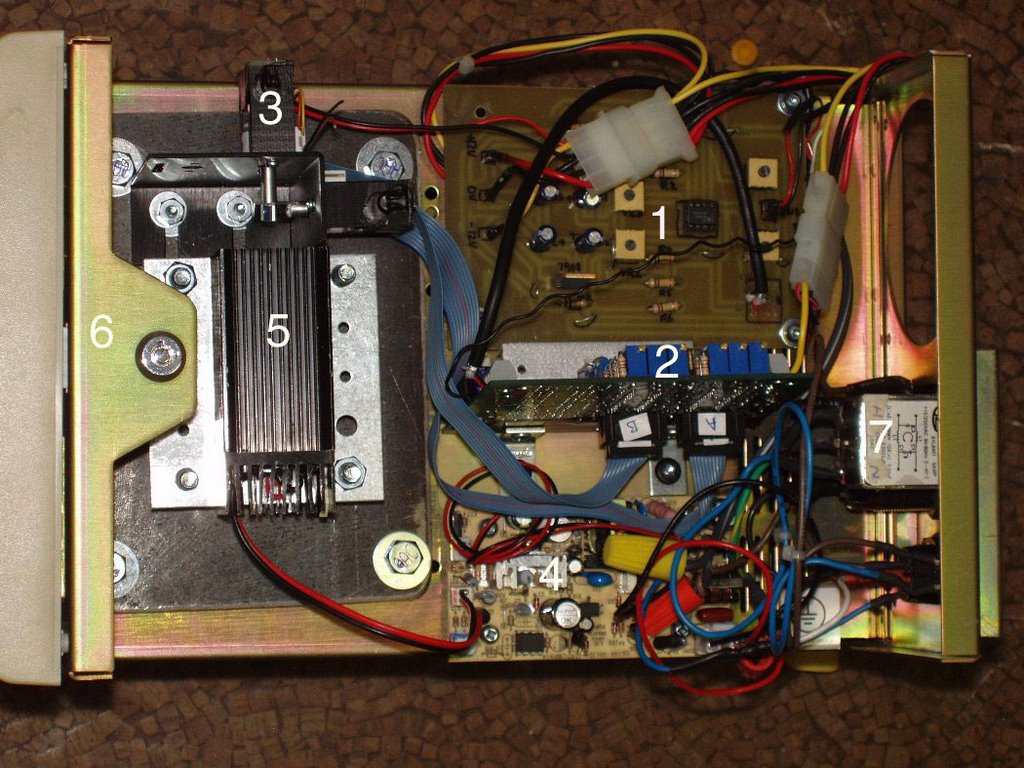
This was the fun part. Fun as in "not particularily, but challenging, frustrating and it gave me something to think about while I was up at 2 AM soothing a screaming child".
That kind of fun
1. DC coupling: This thing is analog! How retro can you get? DC coupling does something to the analog input siganl so it can drive the scanners. I did a lot of work at UBC on signal theory and electronic measurement, but I still don't get what this actually does. Had to build it myself though - from designing the circuit to etching the board to soldering the parts. Worked first time too.
2. Scanner Amplifier: Takes the input from the signal and amplifies it to drive the scanners. I shorted this out when I thought the heat sink was grounded. It still sort of works, but I may have to send it in to get it checked. My bad.
3. Scanners: Your Head Asplode (Joke). These are basically small mirrors mounted on electric motors that oscillate in sync with the signal. One for the X axis and on for the Y axis. Think of it as an etch-a-sketch with light and that's about it.
4. Laser Power Circuit: power to the laser. Nuff Said.
5. Laser: 532nm 30mW DPSS TTL laser to be specific. Hella bright. And green. And dangerous. Still won't cut a spy in half, or even burn a hole in a paper cup, but it's still cool.
6. Case: This was really the hardest part. Where to put it all. I've got a lot of junque electronics around so finding a case was not a problem. Finding a case with 120V power socket, plenty of space, fans and heavy enough not to vibrate too much was the problem. I thought it would be cool to put in all in a translucent green AGFA scanner case, but it wouldn't fit. I finally settled on this 7 bay SCSI CDROM tower from our old library. I don't think anyone would really miss it. I gutted the CD drives (quad speed - how quaint) and power supplies and with a little bit of fudging all fit in. I also mounted the laser and scanners on a 1 kg metal plate with some rubber grommets for vibration control. I'd love to be able to stuff the Amiga board in and run an LCD panel on the outside.
Next version.
7. Power connector: lots of switches - one for the laser (key lock controlled), one for the mains, fuse and breakers. And of course, I can't find the key.
Saturday, July 29, 2006
Laser Show - Amiga 500

Cut to 1986. Expo 86 is on, and I've just graduated UBC and am working my first real job. Which finds me in beautiful Smithers, B.C., just getting off a horrible 20 days of bush work. While waiting for my laundry to be done, I wander into a nearby computer store. On display is the Commodore Amiga 500 - a gee-whiz, video editing, stereo sounding, 256 colouring, GUI interfacing machine with a price tag to match my paycheck. It would have been mine, were it not for the nasty student loans awaiting me back home.
The Amiga is a) not a PC and b) not a Mac. It was one of a few true independent machines from the heady hardware days of the early 80's. Commodore Business Machines, of the famous Commodore 64, bought the licence from Amiga, but due to the overzealous management techniques (and probably the marketing of it as a gaming computer - too early), it never really hit the mainstream. Commodore went bankrupt in 1994 and the licencing went to a German company. The Amiga Community is still around though - a little googling will bring up more information and a rabid fanbase.
I learned of all this while trying to get mine running the Pangolin software.
I won't go into details (mainly as they are a fuzzy set of vague memories of frustration and ordering memory chips from Poland) but she works.
I actually love projects like this - months of little triumphs and little setbacks, until it all comes together one day and just works. It's the Journey, not the Destination.
Friday, July 28, 2006
Laser Show - the beginning

I've been puttering with my very own 1970's era laser show for absolutely no other reasons than a) I like lasers and b) I could.
I tried to build one in high school using the laser from the physics lab, a couple of meccano motors, mirrors and some epoxy glue. That resulted in nearly getting shards of glass embedded in my face when the whole thing exploded. After that, we kind of abandoned the whole idea.
Last year I found a little controller kit at RP Electronics. It uses a cheap laser pointer with three spinning mirrors and connects to a PC parallel port. It made some nead little lissajous patterns, but it was pretty limited. I also realized the trick is to use very small mirrors.
The program is limited in that it only works with Windows 98 (XP is very restrictive about port access ). So while I was looking up a way of making an XP motor controller I came across Pangolin - a company that sells professional laser show software and hardware. Way out of my price range, but they were offering free downloads of their 1990 issue laser show controller program for the Amiga 500. Oddly enough, I had an Amiga 500... three in fact, plus a hard drive interface and various peripherals. Thus is born a Project....
Sunday, July 09, 2006

Thursday, July 06, 2006
Rhinoceros in Lynden Washington
Sorry, it must be summer. God Help Me I'm Done For Another Year. And that can only mean my annual trek to beautiful Lynden, Washington for another Rhinocerosteacher training session at Lynden High School(Go Lions!).
Pricy Neon acrylic - $20 /sheet
Love that neon. Note the lego axles
Might as well do a 4 arm version.
I've been going to these for a few years now and always have a great time. Put on by the good folks at McNeel and Associates, makers of Rhinoceros, and hosted by Bob, Dave and Pete, it's a great experience. I've gotten to play with tools I'd never otherwise have access to, learn from pros and network with other 3d teachers to see what's up. I only wish it were in September to give me a little impetus for the year. This year I designed and cut the Lego Graboid from green neon acrylic. Way too cool.

Laser cutter working on wood prototype

Done - Mmmmm, smoky!

Completed prototype - Lego compatible

Pricy Neon acrylic - $20 /sheet

Love that neon. Note the lego axles

Might as well do a 4 arm version.
Damn Fine Fish n' Chips

When in White Rock BC, be sure to visit Moby Dick Restaurant for some fine eating. Too busy? Don't Panic. Fish n' Chip shops are approaching critical mass in W.R. so there's at least one every ten metres.
Subscribe to:
Posts (Atom)